
Jack Dorsey’s Block, Inc. has quietly released something worth paying attention to. The payments company — best known for Square and Cash App — has introduced mesh-llm, an open-source project that lets users link multiple machines together into a decentralized AI compute network. It’s a small release, but it hints at something considerably larger.
The premise is clean: if you’ve got hardware capable of running large language models, mesh-llm pools those machines and exposes the combined compute through an OpenAI-compatible API. No central server required.
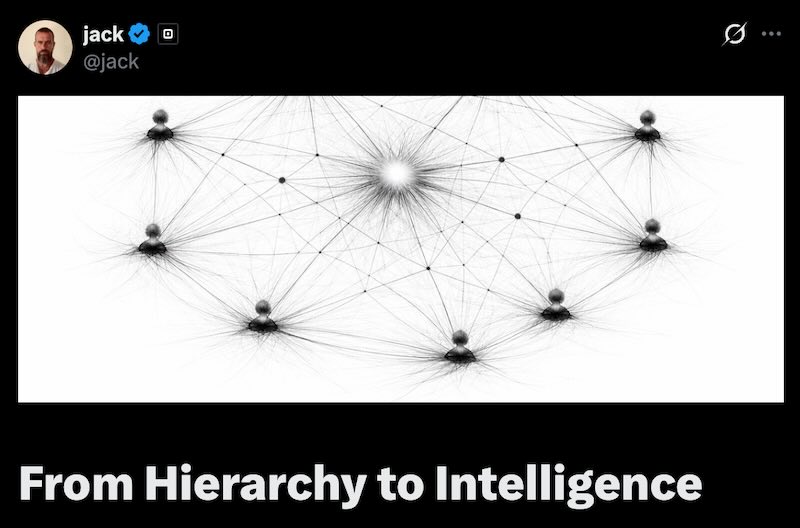
How Block’s mesh-llm actually works, under the hood, the system communicates via RPC over QUIC tunnels — a protocol choice that prioritizes speed and reliability. For node discovery, Block’s mesh-llm leverages Nostr, a protocol originally built for decentralized social networks. Nodes self-organize, join or leave freely, and there’s no single point of failure baked into the architecture.
Inference requests are handled dynamically. A single node handles the workload if it’s capable. If not, mesh-llm partitions the model across machines — splitting dense models layer by layer, and distributing mixture-of-experts models by expert modules. It’s an efficient design, and for power users looking to pool idle home hardware, it’s immediately practical.
This is where things get interesting. Block’s core business is payments, and its ties to the crypto ecosystem run deep. That context matters enormously here.
Bitcoin and similar blockchain networks currently consume massive amounts of compute performing hash calculations, work that carries no intrinsic value beyond securing the network itself. Block’s mesh-llm raises an obvious question: what if that same economic model were applied to something genuinely productive?
Consider the implications of a network where distributed AI compute replaces proof-of-work hashing, connects directly to crypto-native incentives. Contributors could offer spare compute to real AI workloads and earn cryptocurrency in return. That’s a fundamentally different value proposition than abstract “work” securing a ledger.
For the first time, there’d be a direct, functional bridge between AI infrastructure and blockchain economics. Real-world productive computation — actually running models, serving inference — would become the basis of value, not meaningless hashing.
Block hasn’t said any of this explicitly. But given who’s building it and where their business interests lie, the dots aren’t hard to connect. mesh-llm may look like a weekend project for hardware enthusiasts today, but it could easily be the foundation of something far more disruptive tomorrow.
One thing’s certain: Block isn’t just building tools — it’s laying the mesh for the future of decentralized AI.

