
Smartphone manufacturers have spent years convincing us that computational photography beats optical hardware. Then Vivo showed up with miniature telephoto lenses you physically screw onto your phone’s camera system, and suddenly we’re back to carrying glass around like it’s 2010.
Vivo X300 Ultra doesn’t need gimmicks. It’s already packing a 200-megapixel main sensor, a 200-megapixel 3.7x telephoto, and a 50-megapixel ultrawide, vivo X300 Ultra Review. There’s a pro camera grip you can buy separately for tactile shutter control. But the real story here involves two external telephoto attachments that mount directly over the rear telephoto camera — extensions that give you either 200mm or 400mm equivalent focal lengths without relying on digital trickery.
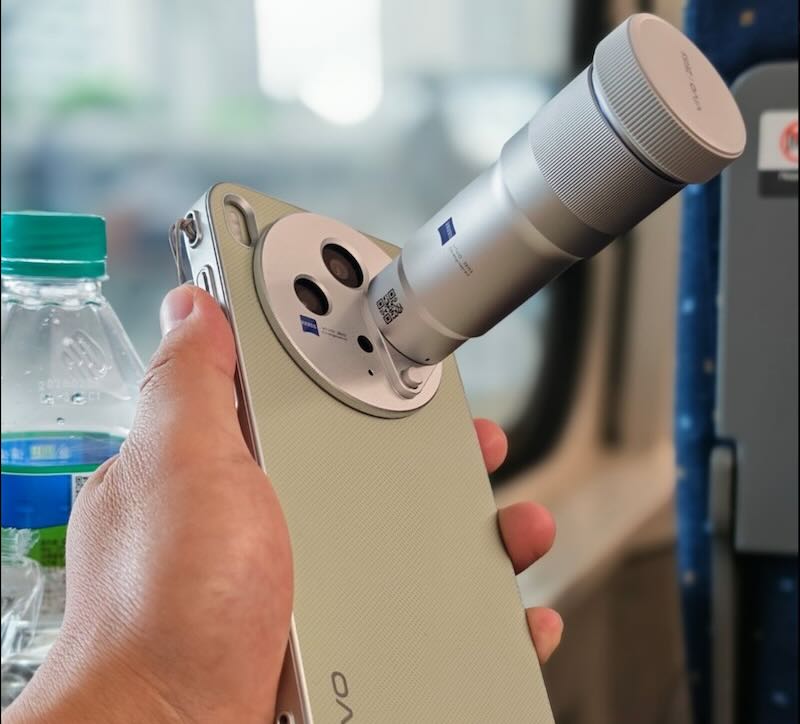
These aren’t lens covers or clip-on accessories from Amazon. Vivo engineered a dedicated mounting system requiring a specific phone case and adapter ring. You align positioning markers, twist to lock, and unlock via a release button mechanism. It’s deliberate. It’s mechanical. And it’s gained traction online after users started posting concert footage and bird photography that looked disturbingly good for a smartphone setup.
Vivo offers two telephoto kit options for the X300 Ultra. G2 lens kit 153 grams and delivers 200mm equivalent focal length, extending the phone’s native 85mm telephoto into proper long-range territory without digital zoom degradation. It’s compact enough to justify carrying around for everyday shooting scenarios where you need extra reach but don’t want to lug dedicated camera equipment.
G2 Ultra pushes things further with a 400mm equivalent focal length and supports 200-megapixel optical output. Version captures detail like individual feathers on distant birds or facial expressions from performers across a stadium. It’s also noticeably heavier at 248 grams and presents a steeper learning curve for handheld use.
Both lenses work with CIPA 7.0-level stabilization when paired with the X300 Ultra, which matters when you’re tracking moving subjects at extreme focal lengths. System handles fast-moving wildlife and dynamic concert environments without turning your footage into a shaky mess.
Users have reported strong optical performance in well-lit conditions, with detail retention that rivals entry-level DSLR telephoto setups. Low-light shooting introduces visible noise, which tracks with the physics of smaller sensors trying to gather information at distance. But during daytime shoots or well-lit events, the image quality holds up beyond what you’d expect from a phone accessory.
Concert-goers near the stage use this tiny telescope setup to grab performer close-ups that would otherwise require press credentials and dedicated gear. Viewers further back combine the optical reach with additional digital zoom for tighter framing, though that obviously compromises quality compared to pure optical magnification.
G2 200mm lens kit gets more praise for versatility across different shooting scenarios. 400mm g2 ultra version delivers dramatic reach but demands more careful handling due to its weight distribution and narrower field of view. It’s purpose-built for situations where you absolutely need maximum distance — think wildlife observation or stadium events from the nosebleed seats.
Compatibility extends across Vivo’s X300 lineup, including the X300s, X300 Ultra, X300 Pro, and even last year’s X200 Ultra. Unified mount system means older lenses work with newer phones and vice versa, which is unusually forward-thinking for smartphone accessories.
X300 Ultra officially launched in China and Europe, continuing Vivo’s pattern of keeping its most ambitious camera hardware away from American consumers, 200mm G2 lens kit is now available for $209.98 at NextBuying. That’s unfortunate because this system demonstrates genuine innovation in mobile photography hardware rather than just throwing more megapixels at computational algorithms.
This setup won’t replace dedicated camera equipment for professionals. But it fills a specific gap for people who want optical reach without committing to interchangeable lens systems. You’ll look ridiculous carrying around what appears to be a miniature telescope mounted to your phone. Then again, you’ll also be getting shots nobody else in your group can match — and sometimes that’s all the justification you need to embrace the tiny telescope life.

