
Smartphone camera arms race has never been more serious, OPPO’s latest move makes that clear. OPPO Find X9 ultra Hasselblad teleconverter kit doesn’t just expand a phone’s optical reach; it restructures the entire relationship between mobile hardware and professional photography. It’s a dual-track strategy that covers both everyday shooting and extreme focal-length scenarios, and it’s the most deliberate camera system OPPO has built to date.
What makes this launch significant isn’t the accessory alone. It’s the fact that OPPO has achieved the first deep integration between Hasselblad’s imaging pipeline and the Find X flagship series — and that distinction matters enormously for anyone serious about mobile imaging.
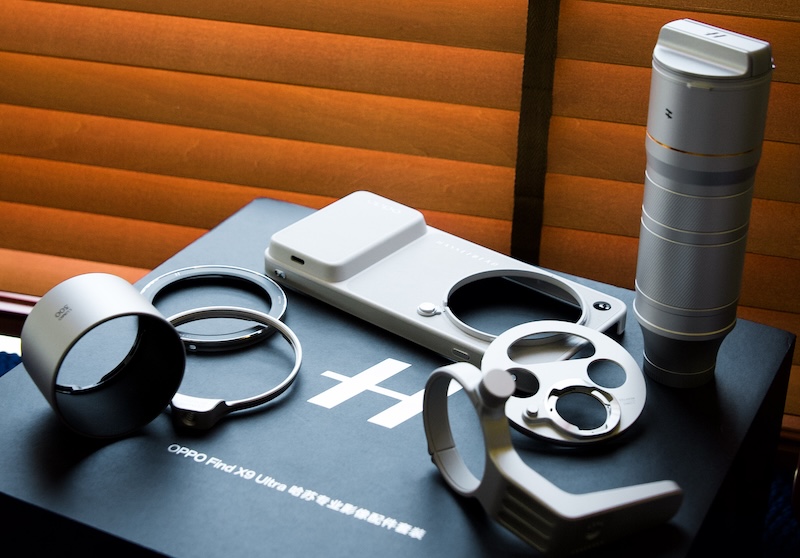
Packaged with the Hasselblad teleconverter Kit is a Hasselblad professional teleconverter ultra, a lens hood, a photography grip protective case, a custom Hasselblad shoulder strap, a 67mm professional filter adapter ring, a teleconverter carrying pouch, and an official certification document. Unlike vivo’s comparable external teleconverter — which leans on polycarbonate construction — OPPO’s solution uses an all-metal build throughout. That’s a meaningful material choice: it communicates intent, even if it does add weight to an already substantial setup.
Teleconverter Kit pairs with a built-in physical teleconverter already integrated into the Find X9 Ultra body itself, giving users two distinct optical pathways rather than one.
The OPPO Hasselblad Teleconverter Kit arrives alongside four engineering upgrades that collectively redefine what flagship telephoto means in 2026. First, there’s a native 10x optical telephoto lens — a specification absent from smartphone flagships for roughly three years. Second, 300mm concert-focused teleconverter pushes long-range reach into territory previously reserved for dedicated mirrorless systems. Third, ultra-high-resolution full-focal-range imaging ensures that no matter where you’re shooting across the zoom spectrum, sensor resolution doesn’t become the constraint. Fourth, and most strategically, Hasselblad’s color science and processing pipeline are now integrated at the system level, not bolted on as a post-processing filter.
Built-in teleconverter shifts telephoto work from software interpolation toward native optical output — that’s a fundamental change in how images are captured, not just processed. For most users, the internal system handles the full range of shooting needs. External Hasselblad kit, then, is positioned for advanced enthusiasts who operate at the boundaries of what mobile glass can do: wildlife, live concerts, travel journalism, and long-distance architectural work.
Available now at NextBuying for $498.98, Teleconverter Kit isn’t trying to sell everyone a professional shoulder strap. It’s building an ecosystem — one where the floor is a genuinely capable 10x optical shooter and the ceiling is a 300mm optical instrument with Hasselblad certification. That kind of range, delivered from a single device with an optional hardware extension, is an argument OPPO’s making with hardware, not marketing. Whether the market’s ready to Find X in that proposition is the real question.

