
Smartphone cameras have been locked in an arms race for years—more megapixels, more modes, more algorithmic polish. OPPO Find X9 Ultra isn’t playing that game. It’s changing the board entirely. Announced ahead of its April 21 Chengdu launch event, it introduces an industry-first 10× native optical zoom, dual 200MP primary cameras, and a prism architecture that genuinely earns the word “breakthrough.” Top-tier 16GB + 1TB Satellite Communication Edition is priced at ¥8,999, a premium that signals OPPO’s ambitions clearly.
This isn’t a spec-sheet refresh. It’s a structural rethink of what mobile optics can do.
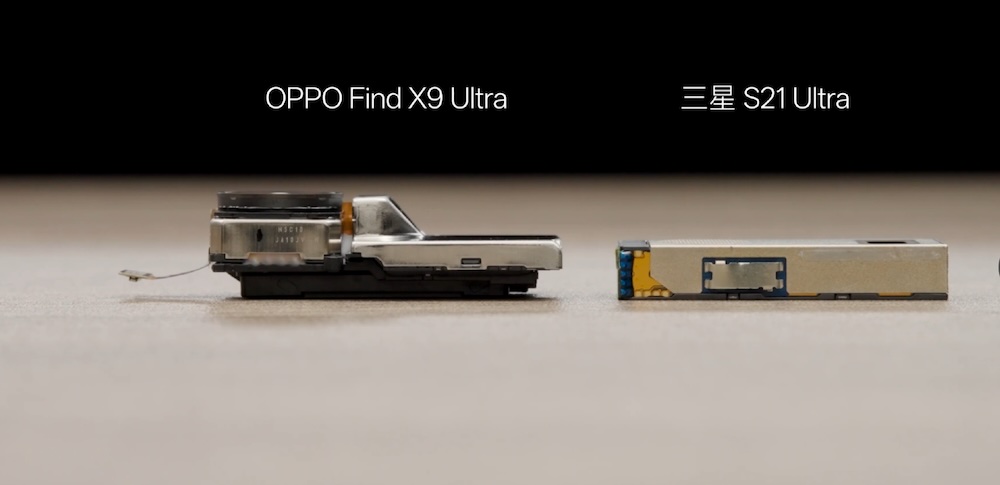
OPPO’s periscope telephoto system uses a 5-reflection optical path—compared to the industry-standard three to four—integrating prism segmentation and 63.2nm nanometer-level polishing to compress the optical path to just 29mm. Result is a true 230mm native focal length housed inside a smartphone body, enabling up to 20× near-lossless zoom.
That’s not a software trick. That’s optics.
To address stray light, a persistent challenge in complex prism designs, OPPO embedded a 4μm air layer within the prism structure. Using total internal reflection, this proprietary solution improves image clarity by 40%. It’s an OPPO-exclusive patent, and it matters more than most press releases would suggest.
OPPO Find X9 Ultra fields two 200MP sensors across its primary focal lengths, and the engineering choices here are deliberate.
Main camera pairs a 1/1.12″ Sony LYT-901—currently the largest 200MP sensor available—with an F1.5 aperture. Light-gathering exceeds traditional 1-inch sensors, stabilization reaches 1.5°, and low-light dynamic range improves by 15% over prior generations. 3× telephoto uses a 1/1.28″ 200MP sensor, largest in its focal class, with an F2.2 aperture delivering a 136% increase in light intake versus its predecessor. OPPO’s LUMO zoom pipeline means cropped 6× images from this lens actually outperform the previous dedicated 6× unit.
Ultra-wide, a 50MP LYT-600 covering 14mm, is the one area where OPPO concedes ground. Its 1/1.95″ sensor is modest relative to the rest of the system—and noticeably behind the vivo X300 Ultra’s larger LYT-818 ultra-wide. That’s a real trade-off worth acknowledging.
A 3.2MP multispectral sensor adds 24-channel spectral sampling, specifically targeting color accuracy in challenging retail lighting conditions—gold jewelry under red backgrounds being the cited example. Hasselblad Master Mode layers on nine film presets, native 4K live photo capture, and one-tap sharing.
OPPO Find X9 Ultra runs Snapdragon 8 Elite Gen5 with LPDDR5X memory and UFS 4.1 storage. 6.82-inch 2K flat display supports 1–144Hz LTPO adaptive refresh, 2600 nits peak brightness, and 2160Hz PWM dimming. A 7050mAh silicon-carbon battery supports 100W wired and 50W wireless charging—reaching 60% in 25 minutes.
Two concerns deserve airtime. OPPO hasn’t disclosed drop-test data for the cut-and-bonded prism structure, so real-world durability remains unvalidated. And with dual 200MP sensors processing 4K live photos simultaneously, burst performance under high frame-rate conditions may hit computational limits.
Still, if real-world output matches what OPPO is claiming, Find X9 Ultra doesn’t just raise the imaging bar—it relocates it entirely. For photographers who’ve wanted a concert-capable, long-range mobile camera without compromise, Ultra might just be the Find they’ve been looking for.

