
The tech industry is on the brink of a paradigm shift, with AI-powered glasses poised to become the next disruptive form factor. With a global eyewear market valued at $500 billion and over 4 billion people wearing glasses worldwide, the potential for widespread adoption is staggering. Recent rumors suggest that Meta-Rayban glasses have already surpassed the million-unit sales mark, a feat that rivals the early days of the iPhone.
AI-powered glasses offer a suite of capabilities that set them apart from other wearable technologies. These devices provide AI assistants with unprecedented contextual awareness, allowing them to see and hear the world from the wearer’s perspective. This first-person vantage point enables continuous, hands-free data collection throughout the day, offering rich contextual information derived from head movements, gaze direction, and immediate visual feedback.
However, the true potential of AI glasses lies not just in the hardware, but in the sophisticated operating systems that drive them. These systems will be crucial in harnessing the full capabilities of AI-enabled eyewear, transforming raw data into actionable insights and seamless user experiences.
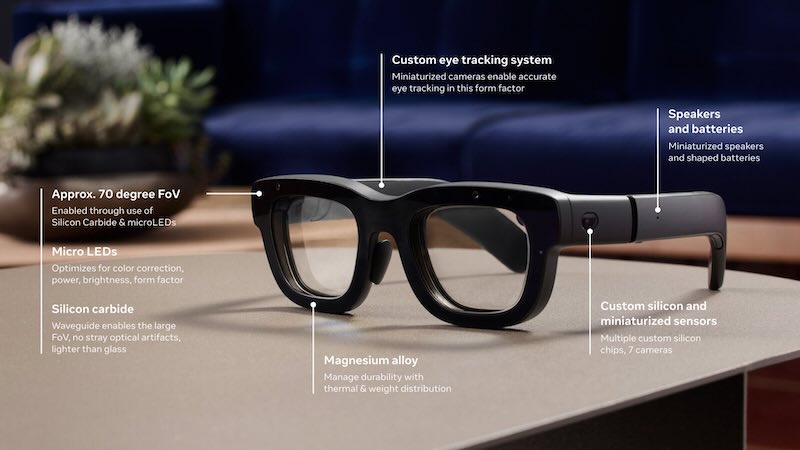
Meta’s unveiling of ORION, touted as the most advanced AR glasses prototype ever built, has sent ripples through the tech community. This “North Star” product is viewed by many as the harbinger of the next great computing platform. ORION boasts impressive specifications that set new benchmarks for AR glasses:
- A 72-degree field-of-view, unmatched in the AR glasses space
- Optical alignment precision to within 1/10 the width of a human hair
- Powerful compute capabilities with optimized power consumption and heat dissipation
- An electromyography (EMG) wristband for intuitive gesture control
- A wireless compute puck for enhanced processing power
ORION represents a significant leap towards truly standalone AR devices. Unlike many current AR glasses that rely on smartphone tethering, ORION is designed to function independently. Its lightweight, cable-free design mimics the appearance of regular glasses, potentially increasing user comfort and social acceptance.
Meta’s long-term strategy, driven by Mark Zuckerberg’s vision, has consistently centered on holographic glasses as the gateway to the Metaverse. The company aims to establish dominance in the next generation of computing, a market they missed during the smartphone revolution. While the goal of replacing smartphones remains distant, ORION marks a significant step towards realizing that future.
As the race to develop AI-powered glasses intensifies, the tech industry stands at the precipice of a new era in wearable technology.

